Gaza thwarts seditious plot, renews allegiance to resistance
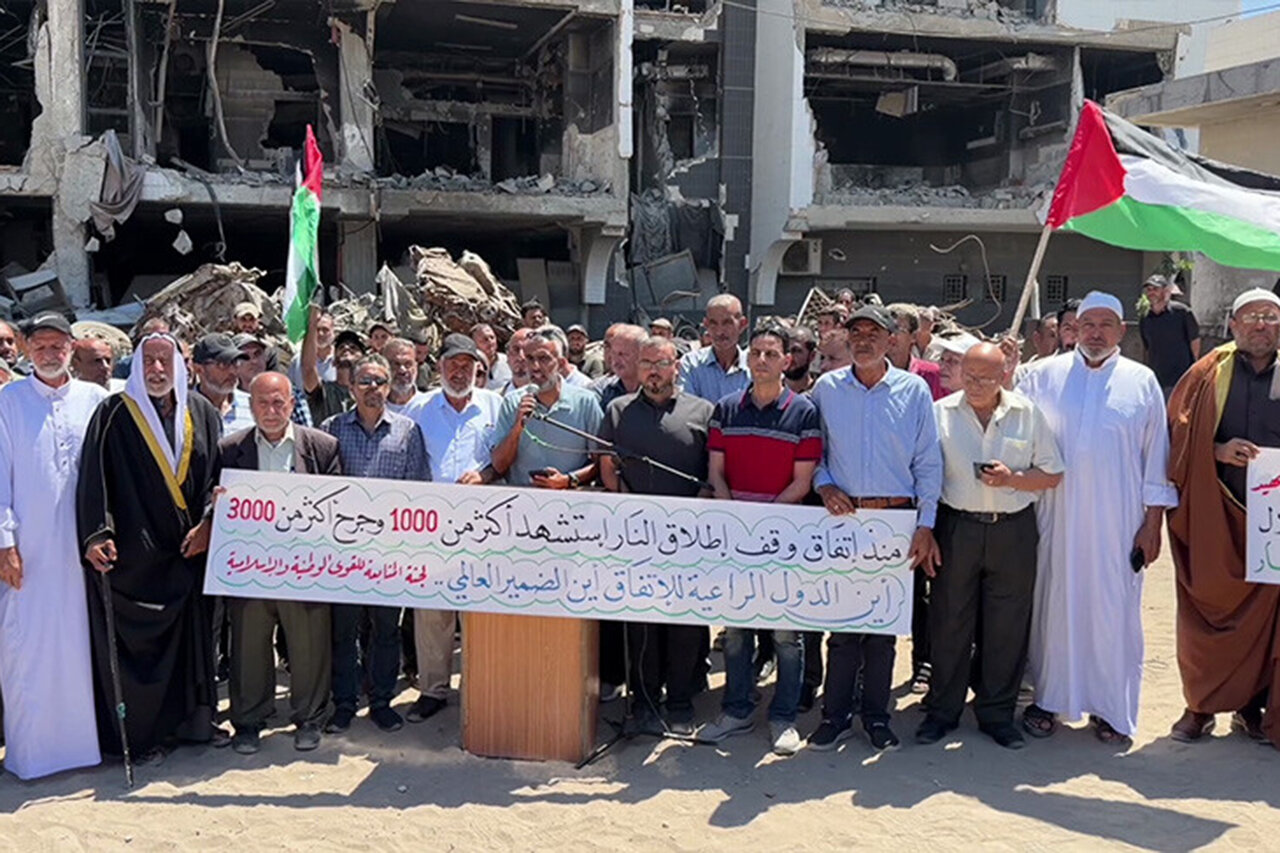
TEHRAN – The devastated and besieged Gaza Strip, a small, impoverished territory, has endured, for more than two years and eight months, one of the worst humanitarian crises in modern history.
Reduced by relentless bombardment and siege to a place no longer fit for human habitation, Gaza is gripped by an array of crises affecting the lives of more than 2.25 million people. Every hour, they struggle to survive, enduring severe hardship while death lurks around every corner in the face of Israeli occupation.
They have lost their livelihoods, their homes, and their possessions, in addition to tens of thousands of their sons and daughters who were killed en masse by Israeli Occupation Forces (IOF), which should shame all humanity. Yet the conscience of the world has remained unmoved, turning a blind eye and a deaf ear to the suffering of Gaza’s oppressed people.
Gaza faces acute shortages of food and medicine, as well as an inability to provide even the minimum supply of safe drinking water, or enough water for basic personal hygiene. At the same time, the housing crisis has become nearly insurmountable. More than 80 percent of Gaza’s homes have been completely destroyed by the IOF, while most of the remaining buildings have sustained severe damage.
Amid the U.S.-backed Israel genocide, another crisis is the near-total collapse of the healthcare system, with virtually no modern or adequately equipped hospitals or medical centers remaining. Schools, universities, and educational institutions have likewise all but disappeared, having been transformed by the genocidal war into overcrowded and deteriorating shelters housing hundreds of thousands of people forcibly displaced from their homes and lands.
Gaza’s financial sector has also suffered a profound crisis that continues to weigh heavily on the homeless. Paper currency has become increasingly scarce after the Zionist regime barred its entry into the Strip since the beginning of the genocide.
Against this harsh and complicated backdrop came suspicious calls for demonstrations demanding the overthrow of Palestinian resistance forces, urging them to withdraw from public life and even surrender their weapons to prevent the resumption of the genocidal campaign.
Many of those leading these protests had left Gaza at the outset of the war and later established media groups whose declared objective was to enable the Israeli regime and its local proxies to gain full control over the Gaza Strip after failing to achieve that goal through the U.S.-backed genocidal war.
Alongside groups using social media as a tool to advance plans formulated with the intelligence services of certain regional actors, similar appeals were issued by leaders of Israeli-backed militias operating inside the so-called “yellow zone” along Gaza’s north and east.
They called on locals to confront Palestinian resistance forces by every possible means, including violence, while pledging financial, military, and even direct operational support to anyone willing to do so.
These militias benefit from extensive IOF backing, including air cover, armored protection, and advanced technological capabilities used to fuel incitement against the Palestinian resistance and its fighters.
According to sources close to the Palestinian resistance, the calls for demonstrations on Friday (June 26) aimed at toppling the resistance front coincided with extensive preparations on the ground. These included plans for coordinated attacks against security and civilian sites, including mosques and displacement shelters, as well as operations targeting figures associated with the Palestinian resistance.
The plans also involved deep incursions by IOF-backed militias toward the centers and western districts of several cities in Gaza, accompanied by military displays intended to secure at least a symbolic victory.
Based on numerous indicators, several principal reasons have been identified behind these calls, which highlight how the planned acts of sabotage were carried out under the direct supervision of the IOF and its intelligence agencies.
The first objective was the Israeli regime’s attempt to ignite internal conflict within Gaza by encouraging public protests and demonstrations while simultaneously sowing discord between prominent Gazan families and the Palestinian resistance.
Throughout the genocidal war, IOF agents carried out numerous assassinations and kidnappings targeting members of well-known Palestinian families before attributing responsibility to Palestinian resistance forces. These incidents initially generated tensions and confrontations. But the Palestinian resistance’s experience enabled it to uncover the truth behind these operations, defuse the resulting crises, and thwart attempts by the regime and its collaborators to provoke internal conflict.
Israel believed that popular demands for improved living conditions and other legitimate rights would ultimately bring civilians into confrontation with the resistance, leading them to blame it for Gaza’s deteriorating situation and potentially sparking an internal conflict that the IOF had sought repeatedly, even before the recent genocidal war.
The second reason was to distract Palestinian resistance forces and prevent them from rebuilding their capabilities and reorganizing their ranks by forcing them instead to deal with widespread protests and internal unrest. Had such unrest materialized, it would have destabilized what remained of Gaza’s urban areas.
Despite the daily bombings, killings, and assassinations carried out by IOF aircraft, these areas still experience a degree of relative stability that allows civilians to recover at least some elements of everyday life denied to them since the outbreak of the genocide.
The Israeli occupation regime understands well that Gaza’s resistance forces perform numerous responsibilities beyond confronting the IOF and its allied militias. They operate under exceptionally dangerous security conditions. The regime therefore sought to impose additional pressure on them, forcing them to abandon their existing plans and redirect their efforts toward confronting disturbances that it believed would fundamentally alter the situation inside Gaza.
The third objective was the Zionist regime’s attempt to absolve itself of responsibility for Gaza’s blockade, starvation, and widespread killing by shifting the blame onto the Palestinian resistance, particularly because it has refused the regime’s demands to surrender its weapons.
Disarmament is a non-negotiable red line for the resistance movement, regardless of the hardships.
Since the beginning of the genocidal war, the regime has sought to distance itself from responsibility for the devastation inflicted upon Gaza’s population.
Israel has repeatedly attempted to blame some of its most significant war crimes on the Palestinian resistance.
Following numerous journalistic investigations, legal inquiries, and documented evidence, the falsity of the IOF’s version of events was exposed. Furthermore, after growing international calls for the regime to comply with international law and fulfill its obligations under the ceasefire agreement, Israel has reverted to its earlier strategy of holding the Palestinian resistance responsible for Gaza’s worsening humanitarian conditions, using calls for protests and demonstrations to reinforce that narrative.
On the other hand, public awareness among the Gaza population, combined with the extensive efforts undertaken by the Palestinian resistance on multiple fronts, served as a bulwark against attempts to spread disorder and undermine security.
Public calls to mobilize against the resistance found virtually no response across most of the Gaza Strip, except among small and socially isolated groups, which Palestinians accuse of being a fifth column operating from within society and exploiting people’s difficult living conditions to sow discord and encourage rebellion.
Despite the extensive media campaign accompanying the calls to spread unrest and disorder, which relied heavily on social media, as well as on Palestinian media figures who had previously left Gaza and were accused of links to foreign intelligence agencies, participation reportedly did not exceed one percent. Instead, many towns witnessed rallies expressing support for the Palestinian resistance, particularly during funeral processions for those killed by the IOF.
Strict security measures were implemented by the resistance forces throughout Gaza, particularly in areas near the “Yellow Line” where information indicated preparations for incursions by IOF-backed militias. Such incursions did occur in places, including Beit Lahia in northern Gaza, the Tuffah neighborhood northeast of Gaza City, and the southern outskirts of Khan Younis.
But Palestinian resistance forces confronted the IOF-trained militias in all of these areas despite the regime’s air support, ultimately forcing them to retreat after inflicting heavy losses upon them.
The Palestinian resistance also used its media platforms to broadcast messages warning people against being deceived by the slogans promoted by those calling for protests. These campaigns attempted to exploit Gaza’s humanitarian suffering by emphasizing the hardships endured by civilians while deliberately avoiding any mention of the Israeli regime’s responsibility for the humanitarian crisis.
In the end, a day that was intended to bring down the Palestinian resistance, strip it of its popular support, and hold it responsible for Gaza’s suffering passed without achieving its objectives. Israel’s efforts, together with those of its local collaborators, failed to weaken Palestinian internal cohesion or damage Gaza’s social fabric.
The people of Gaza have reflected their allegiance to their land and holy sites while reminding the world that their cause is just, and that the rights taken from them under IOF occupation neither expire with time nor can be abandoned, regardless of the sacrifices required or the war crimes they continue to face.
Leave a Comment