The sealed watermelon of the Mecca Agreement
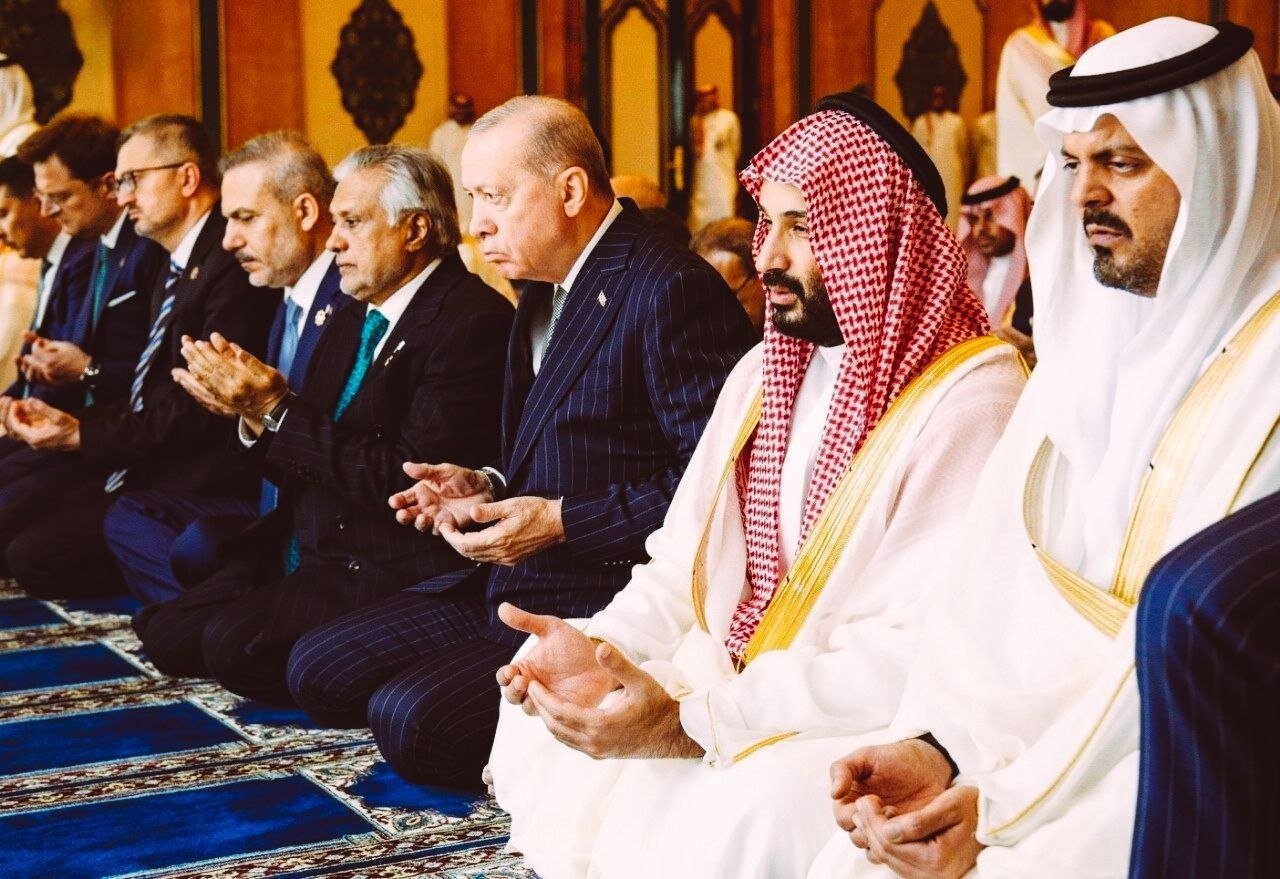
TEHRAN — Three leaders signed a promise inside Al-Safa Palace on Friday: an armed attack on Saudi Arabia, Turkey or Pakistan will be treated as an attack on all three. Turkish Foreign Minister Hakan Fidan compared the clause to NATO’s Article 5. The full text stays sealed, unread outside the rooms where it was drafted. Persian has a phrase for exactly this situation: a watermelon still in its rind, “Hendevaneh-ye dar basteh.”
Nobody can tell you if it is sweet until somebody cuts it open. In a region where the sliced watermelon, red, black, white and green, has doubled as a flag once banned outright, that metaphor carries more than uncertainty. It points toward the one cause that could unite these three capitals and other capitals, and it is not the clause they just signed.
An overdue admission
Riyadh built its security for decades around one idea: Washington’s protection was worth every base and every concession. February 28 broke that idea in public.
Bases advertised as pillars of stability instead became coordinates on Iran’s target list, illustrating Tehran’s stated doctrine that self-defense requires striking the sources and facilitators of aggression.
That is the quiet admission inside the Mecca pact: American protection has a ceiling, and Riyadh may have just measured it the hard way.
The Islamic Republic has consistently argued that foreign militaries do not secure this region; they endanger it, and that lasting security must come from the people who live here.
Watching Saudi Arabia, Turkey and Pakistan act on a version of that argument, even a partial one, deserves an honest welcome.
Iran has no interest in seeing three Muslim-majority states fail at reducing their dependence on Washington. It shares a history, a faith and a neighborhood with all three, and Tehran’s hand stays open to Riyadh, Ankara and Islamabad.
The trouble with wanting it both ways
Goodwill is not blank credit. Whatever these three governments are building, every old arrangement stays in place too.
Turkey still sits inside NATO, an alliance with its Article 5.
Saudi Arabia still hosts American forces. Nine days before the Mecca ceremony, Washington signed a civilian nuclear deal with Riyadh, then declared a day later it would only take effect once Saudi Arabia joined the “Abraham Accords.”
Crown Prince Mohammed bin Salman has said he will not normalize with Israel without a genuine path to Palestinian statehood. Hold that line, because an Islamic defense architecture cannot share an address with a diplomatic bridge to an illicit, bloodthirsty genocidal regime.
You cannot have your cake and eat it too.
Condemning that genocide in speeches while leaving the door open for future recognition may appear as delay dressed up as patience.
Or in the case of another signatory of the pact that has had formal diplomatic relations with the regime since 1949, delivering fiery denunciations while leaving a deliberate door open through reduced diplomatic representation and quiet back-channel engagement cannot remain hidden from the Islamic world.
A pact sealed in Islam’s holiest city should demand more: zero presence for the genocidal occupying regime across the Islamic world.
History keeps grading these choices
Riyadh has run similar experiments before. Its 2015 war on Yemen that supposedly included various pacts and coalitions was projected to be brief. It dragged on for years against a poorer nation and left Saudi refineries exposed to the strikes this pact is meant to deter.
Sunday morning, around 48 hours after the ink dried, Ansarullah drones hit an Aramco refinery in Jizan, one of the latest strikes since the Yemeni armed forces declared a Red Sea blockade last month.
As of writing this, neither Turkey nor Pakistan have sent soldiers, an honest preview of a pact with no joint command, no shared radar picture, nothing that makes its central promise automatic rather than negotiable.
The medium term looks just as crowded. Pakistan’s army watches India and a restive Afghan border more closely than the Red Sea.
Turkey still has troops committed in Syria, a standoff with Kurdish forces, bases stretching to countries such as Somalia, and proximity to Israeli jets over Syrian skies.
Stack Turkey’s NATO membership on top of its new Mecca commitment, and the region has layered a second supposed alliance atop a first without agreeing on what triggers either.
Europe ran that experiment in 1914: reasonable-sounding treaties, signed for reasonable-sounding reasons, supposedly turned one assassination into a bloody four-year catastrophe because nobody had settled what an attack meant.
Overcomplicating regional security has failed before. It will fail again if the real work becomes juggling many separate obligations instead of naming the one actor that keeps setting this region on fire.
None of this is complicated. The occupying geocidal regime in Tel Aviv, financed and shielded by Washington, remains the engine of instability here, from Gaza to Beirut to the Red Sea. A security architecture that cannot say so plainly is decoration.
Mecca’s symbolism demands more than a signature; it demands the unity the watermelon has carried for years, the same red, black, white and green Palestinians raised when their own flag was outlawed.
That fruit does not stay sealed forever. The one signed on Friday still does. Iran’s formula has not changed: security for all, or security for none. Everything else is arithmetic.
Leave a Comment