‘Not our war’: South Koreans rally against US pressure, reject military involvement in West Asia
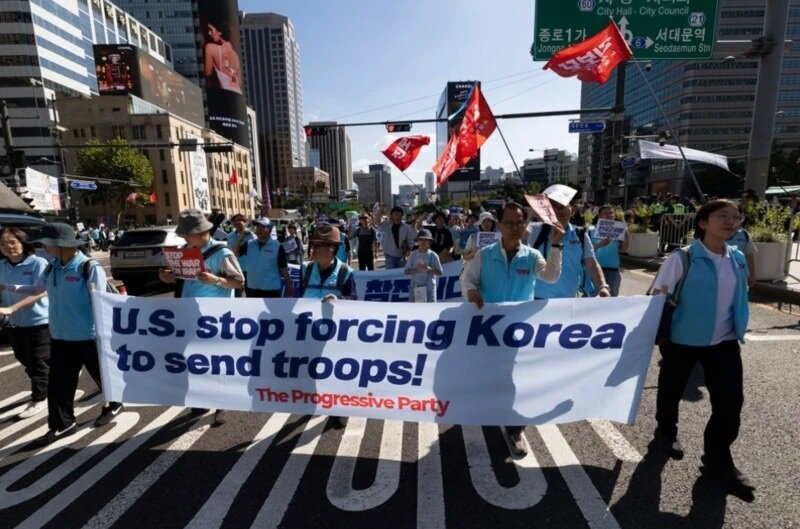
TEHRAN – Hundreds of South Korean citizens, anti-war activists, and civil society groups staged a massive rally in central Seoul on Saturday to fiercely reject US demands for military involvement against Iran, urging their government to uphold its constitutional sovereignty and resist Washington’s aggressive arm-twisting.
The widespread demonstration took place just a day after President Lee Jae-myung officially ruled out combat troop deployments that would draw the East Asian nation into the ongoing regional conflict.
Footage from the heart of the South Korean capital showed demonstrators chanting slogans including “Reject” and “Oppose the deployment of South Korean troops,” while waving anti-war placards, unfurling banners, and staging street performances demanding peace and an immediate halt to foreign military adventurism.
Rally participants condemned the hostile actions of Washington and Tel Aviv, warning that any military entanglement alongside American forces would render Seoul complicit in grave violations of international law.
“The US and Israel’s invasion of Iran is clearly a war of aggression […] Sending troops in any form would effectively support the US war of aggression, put Korean soldiers at risk, and potentially expose Korean citizens in Iran to harm,” said a protester addressed to the gathering.
Rally members urged Seoul to act according to its Constitution and the public interest, rather than bow to pressure from Washington.
Demonstrators also voiced skepticism over the government’s lingering ambiguity regarding naval operations in West Asian waterways, particularly concerning the prospective operational scope of the Cheonghae Unit.
“[President Lee] did not specify what would happen regarding the operational control of the Cheonghae Unit, nor did he firmly reject the US request for deployment,” a demonstrator noted.
“I came here because I hope our government will be able to speak more independently in the future […] This is an invasion war that even the United States has abandoned, and a war that has not gained recognition from the international community,” she added.
On Friday, President Lee had stated in unambiguous terms that “there will be no participation or intervention in war,” ruling out troop deployments that would involve ROK in the conflict.
Speaking at a news conference in Seoul, the South Korean leader sought to distance his administration from Washington’s military objectives.
“There won’t be deployment that would involve or enter war. I can tell you that very clearly,” Lee told reporters. “We won’t deploy military assets in any form to that end.”
Nonetheless, authorities in Seoul have been reviewing potential measures to strengthen the presence of the Cheonghae naval unit—a counter-piracy mission originally stationed off the Horn of Africa—under the rubric of protecting commercial vessels and energy shipments navigating the strategic Strait of Hormuz.
“[It] is also clear that we must do the minimum as other countries do to protect our commercial shipping and crude shipments, and also the safety of our people,” Lee added, attempting to navigate severe domestic anti-war sentiment on one hand and relentless pressure from the White House on the other.
Earlier in May, Defence Minister Ahn Gyu-back noted that Seoul would consider a “phased contribution” to efforts to restore safe navigation through the strait, potentially including personnel, intelligence-sharing and military assets. He said direct military participation had not been discussed in detail.
The Strait of Hormuz remains an indispensable conduit for international energy supplies, and the escalating regional crisis—instigated by foreign aggression—has disrupted key shipping lanes, putting immense pressure on Seoul to safeguard its commercial navigation without becoming an accessory to unlawful military campaigns.
The official reluctance from Seoul comes amid deepening fissures within the long-standing military alliance between Washington and its East Asian partner. US President Donald Trump has repeatedly castigated South Korea for what he characterized as insufficient support for Washington’s war effort against Tehran.
In an apparent retributive move that has alarmed strategic circles in Seoul, the Trump administration recently scaled back major joint military exercises between US and South Korean armed forces.
Yet, rather than compelling South Korea into compliance, Washington’s coercive maneuvers have fueled widespread popular indignation. Earlier this month, dozens of South Korean anti-war activists and civil society leaders gathered directly outside the fortified US embassy compound in central Seoul. Unfurling banners that read “Do not join a war of aggression,” demonstrators directed their chants toward the presidential office, declaring: “We cannot send our young people into a sea of death!”
The prospect of third-party involvement in the Persian Gulf has drawn stern and unambiguous warnings from diplomatic authorities in Tehran, who have consistently cautioned regional and extra-regional actors against aligning with hostile US operations.
Iranian Foreign Ministry spokesman Esmaeil Baghaei has repeatedly underlined that any operational involvement by foreign forces in the Persian Gulf or the strategic Strait of Hormuz will be treated as direct participation in the unlawful US campaign.
In a comprehensive statement released in the Korean language on his official X account on September 7, Baghaei underscored the 64-year history of diplomatic, cultural, and economic relations between Tehran and Seoul, reaffirming that the Islamic Republic has always placed great value on mutual respect and its friendly ties with the South Korean people.
However, Baghaei stressed that the Iranian nation is exercising its legitimate, inherent right to self-defense against unprovoked military strikes and war crimes targeting civilian and infrastructure sites.
Under these circumstances, Baghaei warned, any military facilitation or presence alongside foreign forces in regional waters directly aids the aggressor. Urging Seoul to preserve an independent foreign policy grounded in international law rather than subverting its national interests for American adventurism, the spokesman said:
“No sovereign and responsible country will submit to US pressure and blackmail to collude in committing acts of aggression and heinous crimes against the great Iranian nation.”
Leave a Comment