Kazakh investment at Shahid Rajaei Port to triple bilateral trade, guarantee 1.5m-ton-transit
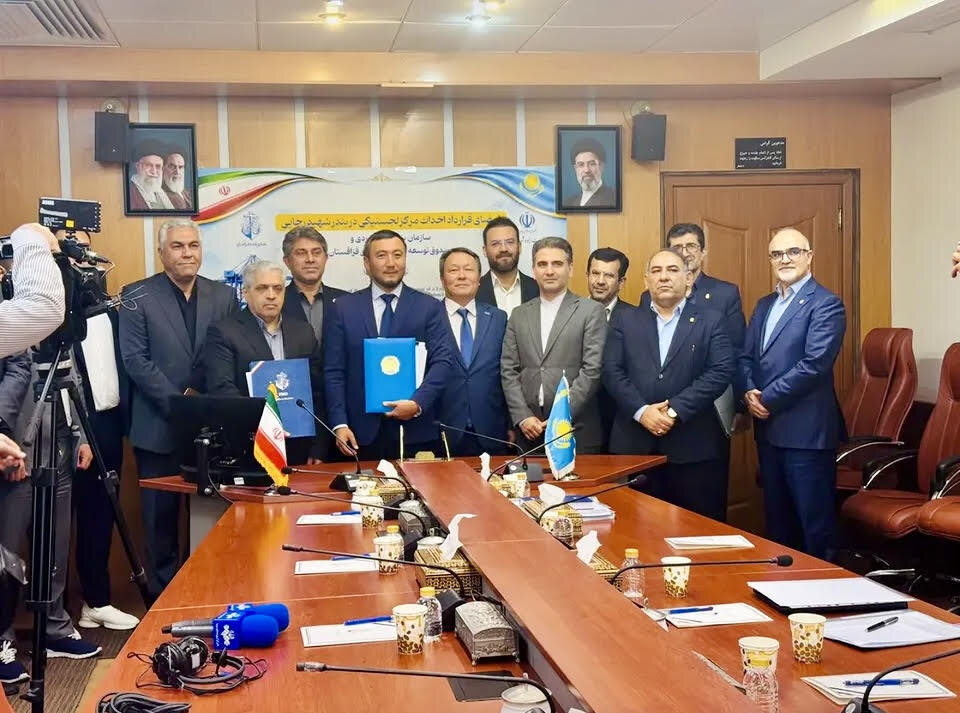
TEHRAN- The Head of Iran’s Ports and Maritime Organization said that with the implementation of the Kazakhstan investment agreement at Shahid Rajaei Port, the volume of goods traded between the two countries will increase threefold, and the annual transit of 1.5 million tons of goods will be guaranteed.
According to Mehr News Agency, Mohammad Shakibi-Nasab, made the remarks on June 28 at the signing ceremony of the Kazakhstan investment agreement at Shahid Rajaei Port that this agreement is an important step towards realizing the policy of attracting foreign investment and developing the North-South International Corridor.
He stated that this project is being implemented with the support of the Ministry of Transport and Urban Development and within the framework of the Ports Organization's plans to strengthen Iran's transit position.
Stating that this agreement guarantees the annual transit of 1,500,000 tons of goods through the territory of the Islamic Republic of Iran, he added that the realization of this goal, in addition to increasing Iran's share of the regional transit market, will lead to the improvement of economic indicators, an increase in transit revenues, and the enhancement of the position of the country's ports in the international transport chain.
The Deputy Minister of Transport and Urban Development stated that this investment, in addition to developing infrastructure and supplying port equipment, will provide the ground for job creation, increasing the operational capacity of Shahid Rajaei Port, and boosting the ports located along the North-South Corridor.
Referring to the strategic position of Kazakhstan in the regional transport network, he said: Kazakhstan, as one of the important logistics and transit hubs of the region, can play an effective role in making the North-South Corridor more active. The presence of investors from this country in Shahid Rajaei Port, whether in the field of infrastructure development or in the field of equipment supply, will help boost this international corridor and expand the economic cooperation of the two countries.
Shakibi-Nasab, emphasizing the economic and social effects of this investment, clarified: The implementation of this project, in addition to creating new job opportunities, will lead to the prosperity of ports along the North-South Corridor, increasing the productivity of port infrastructure, and the growth of trade exchanges between Iran and Kazakhstan, so that the volume of goods traded between the two countries will increase threefold with the implementation of this agreement.
Head of Kazakhstan's Trade Development Fund: Shahid Rajaei Port will become core of first Kazakh port
At the end of this ceremony, Aman Mal Gazhvarov, Director General of the Trade Development Fund of the Republic of Kazakhstan, expressing his satisfaction with the finalization of this agreement, considered it a strategic step in developing the economic and transport cooperation between Iran and Kazakhstan and said: We have been working continuously on this project for nearly a year, and today we are happy to witness the signing of this agreement.
Emphasizing the long-term vision of this project, he added: We do not consider this project merely a dock, warehouse, or terminal, but rather regard it as the initial core of establishing a Kazakh port in Shahid Rajaei Port; a project that can play an important role in the development of regional transit corridors.
The Director General of the Trade Development Fund of the Republic of Kazakhstan, referring to the investment commitment of the Kazakh side, stated: The amount of our investment commitments in this project is about 1,500,000 dollars, and we will seriously follow up on its implementation.
Gazhvarov concluded by referring to the trade capacities of the two countries: Currently, the value of goods traded between Iran and Kazakhstan is about 400 million dollars, and we hope that with the implementation of this agreement and the operation of the logistics center, this figure will at least double or triple.
Shahid Rajaei Port will become Kazakhstan's logistics hub in Persian Gulf
According to Mehr News Agency, the investment agreement and the creation of a logistics center for the Republic of Kazakhstan in the hinterland of Shahid Rajaei Port were signed on June 28, in the presence of Mohammad Shakibi-Nasab, Head of the Ports and Maritime Organization, and Ontalap Onalbayev, Ambassador of the Republic of Kazakhstan in Tehran.
The establishment of a Kazakh logistics center in the hinterland of Shahid Rajaei Port is considered one of the most important joint projects between Iran and Kazakhstan in the field of transport, logistics, and trade, which will be implemented with the aim of strengthening economic and transit cooperation, developing trade exchanges, and enhancing the position of the North-South International Corridor.
This center will operate as a base for consolidating, storing, processing, distributing, and transiting Kazakhstan's export, import, and transit goods.
By facilitating the supply chain, reducing the time and cost of cargo transportation, and increasing efficiency in logistics processes, it will play an effective role in developing the economic and commercial cooperation between the two countries.
Also, utilizing the capacities of Shahid Rajaei Port as Iran's largest commercial port will provide the possibility of direct access for Kazakh goods to open waters and the markets of the Persian Gulf region, East Africa, the Indian subcontinent, and other international markets, and will further strengthen Iran's position as a link between Central Asian countries and the global trade network.
Hossein Abbasnejad, Director General of Ports and Maritime Department of Hormozgan Province, had said earlier in the morning of the ceremony day: "Negotiations and coordination with the Kazakh side have been ongoing for about a year, and preliminary memorandums of understanding were signed earlier. Today, this contract will be officially signed."
He added: "This project involves the construction of a logistics center at Shahid Rajaei Port on an area of about 15 hectares, which will serve as a link in the chain of logistics centers in Kazakhstan, origin ports, and Shahid Rajaei Port for the development of transit."
Referring to the investment amount for this project, he said: "The investment is about $25 million, which will be made as foreign direct investment by the Kazakh side."
Abbasnejad described this project as one of the few examples of foreign direct investment in Iran's ports in recent years and added: "In this project, unlike some past projects, 100% of the investment is made by the Kazakh side."
He continued: "A construction period of two years has been considered for this project, after which operation will begin. In the operational phase, the annual transit volume is estimated at about 1.5 million tons, which has the potential for increase and expansion."
The Director General of Ports and Maritime Department of Hormozgan Province stated: "The contract duration is 27 years, which will include about 25 years of operation, and provisions have been made for review in five-year periods according to future conditions and increases in transit volume."
Back in last December, Mohammad Ali Dehghan-Dehnavi, deputy industry minister and head of the Trade Promotion Organization (TPO), said: “Trade ties between Tehran and Astana are entering a more dynamic phase following the recent presidential visit to Kazakhstan, with both sides seeking to expand economic cooperation through logistics projects and regional partnerships.
He said: “Cooperation between provinces of the two countries was a key pillar of bilateral trade policy, adding that political relations had outpaced economic ties despite strong potential.”
Speaking at a meeting on logistical cooperation with Kazakhstan, attended by senior officials and business representatives, Dehghan-Dehnavi said closer coordination and joint infrastructure projects were needed to rebalance economic relations and raise trade volumes.
EF/MA
Leave a Comment