The funeral in Tehran that the West cannot explain
MADRID - Every history is a narrative: an attempt, from a specific political present, to answer how that present relates to the pasts it reconstructs and the futures it anticipates. There is no neutral way to tell it. Composing a historical discourse is an interpretive, aesthetic, moral and political exercise, and it is so even before a single fact has been discussed.
Writing about Iran requires accepting this as a starting point. The Western account of the Islamic Republic is driven by an epistemological urgency: to catalogue, domesticate or dismiss whatever escapes its liberal categories. When confronted with a political project born outside the secular matrix, European and American thought tends to diagnose a lack—the absence of its own institutions—and translates that lack into a historical anomaly that must be corrected.
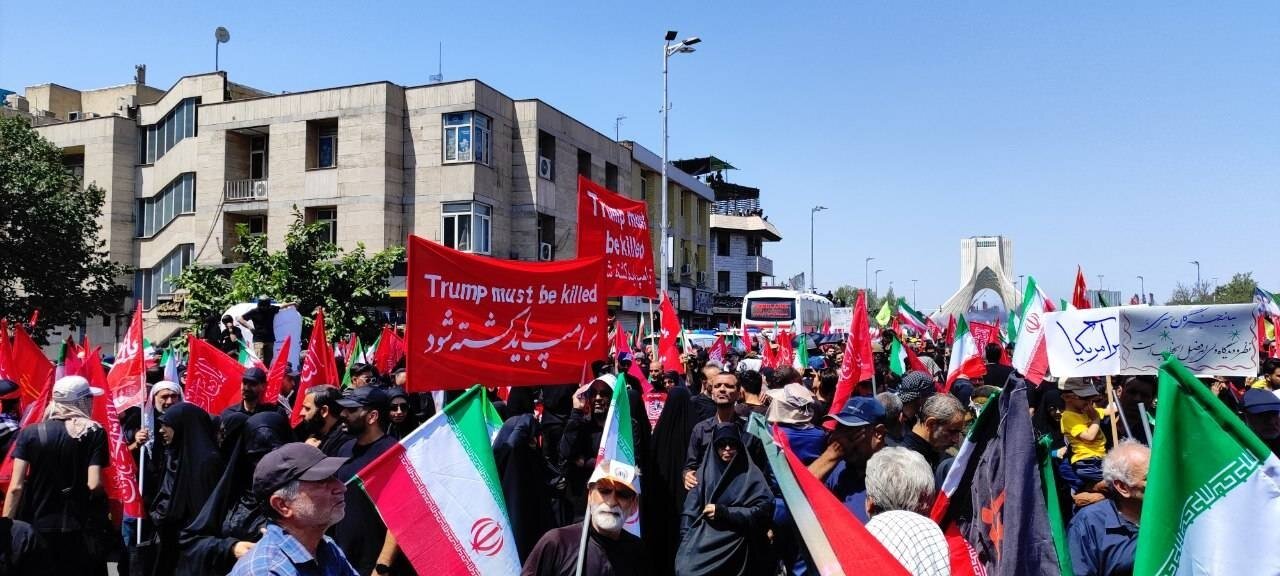
On June 6, 1989, millions of Iranians filled Tehran's streets to bury Ayatollah Ruhollah Khomeini. Mourners beat their chests to funeral chants, while the wailing of women rose above the din. Records recognize that funeral as the largest proportional gathering ever assembled: some 10.2 million people, roughly one-sixth of Iran's population.
That funeral took place in a moment of almost absolute discursive stability. In the absence of an alternative referential system, the relationship between words and their referents was fixed at the level of the multitude itself: millions of present bodies suppressed any attempt at public reinterpretation of the sign. One consequence was that Khomeini's figure, and with it the Islamic Republic itself, remained for years unthinkable outside the framework of historical victory. Political defeat had no vocabulary within that symbolic horizon.
During Khomeini's years as Wali e Faqih, the supreme magistracy of Iran's constitutional architecture, public space was saturated by the signifier "martyr", particularly during the Iran-Iraq war, known officially as the "Sacred Defense". The Islamic government granted the martyr, his family and his close circle a structural position. To die that way symbolically reordered the individual's place and lineage within the political-theological body, incorporating them into a discourse of honor and sacrifice that removed grief from the private sphere and turned it into an act of state sovereignty.
Documentary filmmaker Morteza Avini spent years accompanying young men who left their families to head to the war fronts with the expectation of martyrdom. The question running through his films is simple: what drove those young men to walk towards death with that disposition? In Avini's framework, Western history appears as a history of the material—the body, technique, innovation—where each era is defined by its technological transformations. Against it, he proposes an unwritten history, that of the soul, linked to the tradition of the prophets and imams in Twelver Shi'ism. Khomeini occupies, within that scheme, a place exceeding politics: he appears as a figure in that same spiritual continuity, someone who inaugurates a new chapter in the history of the soul. From there, war ceases to be a territorial conflict and becomes a theological project demanding willing subjects. What Avini's cameras register are multitudes traversed by a language of love, duty and devotion, in which dying in combat is inscribed within a narrative of meaning repeated with methodical rigour.
was part of that discursive framework, with Imam Khomeini as its most visible expression. Imam Khomeini's funeral occurred when nothing threatened that centrality: words and their referents remained fixed at the level of the multitude, without any alternative system capable of destabilizing them.
Ayatollah Ali Khamenei's funeral, which began on Friday (July 3) and continues until Thursday (July 9), is taking place in a radically different historical moment. Imam Khamenei died on February 28, 2026, in a joint US-Israeli airstrike that marked the start of that year's war against Iran. The funeral, originally scheduled for March, was postponed until now. Processions have travelled through Tehran, Qom and the Iraqi cities of Najaf and Karbala, before the final burial in Mashhad.
The geography of the cortege traces a precise political cartography. By crossing into Iraq to stop at Shiite shrines before returning to Khorasan, the route has drawn a geography of devotion that ignores national borders established by British colonialism in the early twentieth century. What unfolds is not a simple pilgrimage, but the affirmation of a political space articulated around Shiism's holy places rather than maps drawn by European powers.
Faced with this display, the hegemonic Western narrative has explained the scale of attendance—between 10 and 15 million—in terms of coercion and strict governmentality. According to this reading, the numbers represent biopolitical control, orchestrated with free transport, accommodation and food provided by the state. This interpretation connects the present with a fabricated past: the Islamic Republic as an anomaly that interrupted a supposed secular normality. It projects a future where the only option is this model's disappearance and replacement by a form aligned with the liberal norm.
Reducing the mobilization of millions to a calculation of material incentives reveals the limits of liberal thought. The Western epistemological framework lacks tools to understand a political subjectivity forged outside its matrix. Faced with a collective effect that does not respond to individual interest or consumption, the instinctive reaction is to deny its autonomy and attribute it to external manipulation. It rejects that sacrifice, devotion and grief could operate as genuine political motors, capable of structuring human action independently of capitalism's frameworks.
There is another reading, anchored in Shiism's own political tradition, which explains Ayatollah Khamenei's funeral in direct relation to Imam Khomeini's. The main difference lies in the position occupied by the signifier of martyrdom within the political field. In 1989 that field was saturated: martyrdom operated as hegemonic, organizing public meaning without friction. Today, it competes in a more fragmented terrain, subjected to decades of hybrid warfare, economic sanctions, and disinformation. But far from weakening, that fragmentation has tested the solidity of a bond depending not on coercion, but on living tradition. The popular response has been, once again, massive. The state has not had to summon anyone: the call has come from the streets, from neighborhoods, from mosques and hüseyniyés that have woven a parallel network of grief alongside the official one. What appears to the external gaze as "instrument" or "resource", for Iranians is the natural expression of a loyalty that need not be remembered because it forms part of the substrate of their political identity.
The state apparatus has deployed symbolism: red and black combining grief, martyrdom and promise of vengeance; the explicit reference to Karbala; Ayatollah Khamenei's clenched fist turned into the official commemorative image. But that deployment reflects what was already in the streets. The state does not manufacture sentiment; it gathers it, amplifies it and returns it to the community as recognition. Iranian political theology is not an emergency resource, but the deep grammar of a society that has made martyrdom a central category of its historical experience. What in 1989 was shared unconsciously, in 2026 remains the hard core of collective identity, now explicit and defended with greater awareness because the external enemy has multiplied its attacks.
The scale of public participation shows that the signifier of the martyr has not exhausted itself, but recovered renewed intensity. It is no longer an unquestioned background, but its invocation now requires conscious adherence, a reiterated choice in the face of hostile propaganda. Decades of hybrid warfare have not eroded martyrdom's capacity to mobilize political effects and structure collective identification. On the contrary, they have tested and reinforced it, demonstrating that Iranian political theology possesses its own dynamism that external readings not only fail to capture, but are determined to deny—because recognizing it would imply admitting the legitimacy of a project alternative to the liberal order.
Every narrative about Khamenei's funeral selects its past and projects its future, and each selection is a political wager on what counts as continuity and what as rupture. The past does not wait passively to be read: it is activated and put to work every time a present needs to signify something. What is taking place this week on the streets of Iran and Iraq is the materialization of that dispute. Faced with attempts to reframe the Islamic Republic within foreign categories that condemn it to incomprehension or extinction, the funeral has functioned as a symbolic waterproofing: a demonstration that the Iranian political project continues to generate its own terms of existence, its own martyrs and its own sense of history. The cortege has not limited itself to bidding farewell to a leader; it has reclaimed the autonomy of a political tradition that insists on narrating itself in its own words, over its own bodies and along its own sacred geography.
Leave a Comment