“Shouldn't a school always be a safe place?”: Minab student asks US schoolchildren
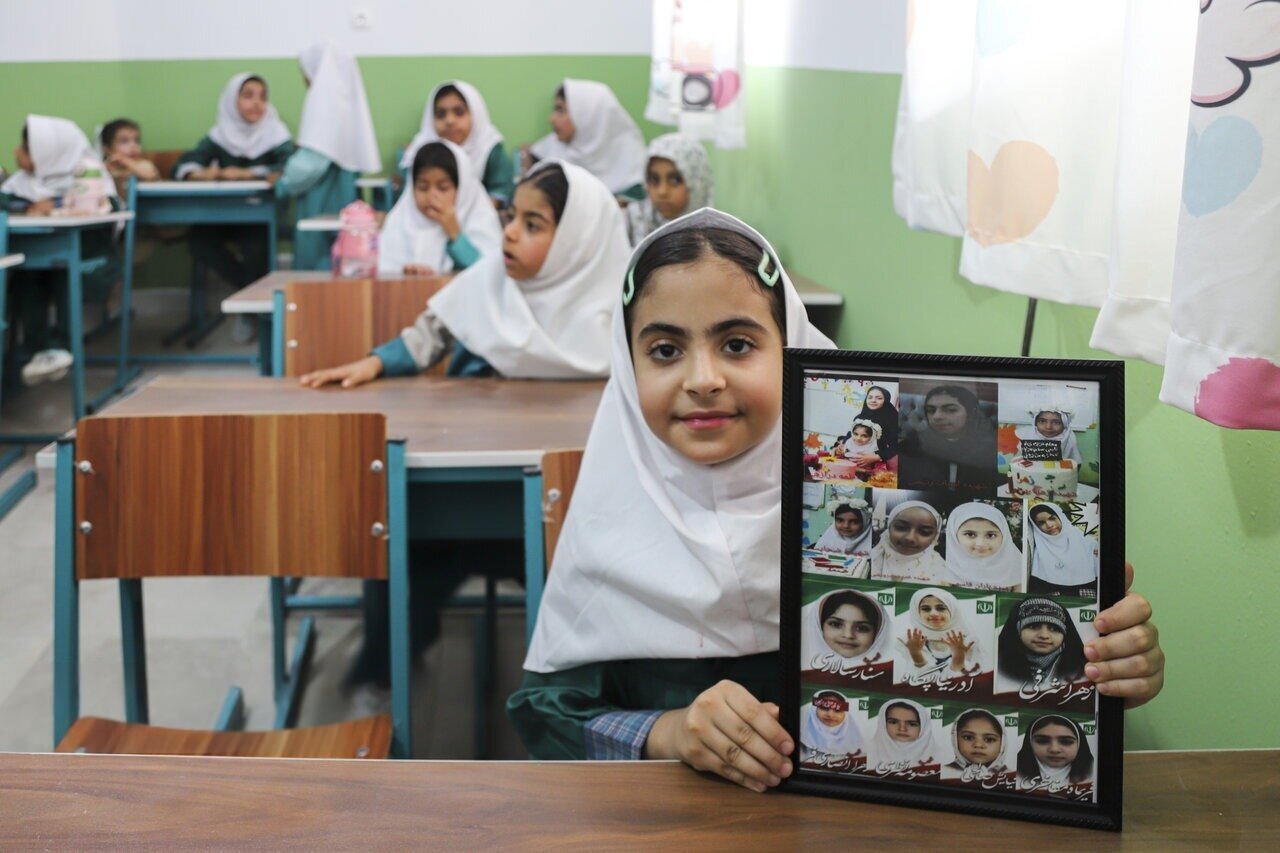
TEHRAN – A student from Minab has addressed American students, calling for schools to remain safe spaces for children and remembering classmates who were killed when Shajareh Tayyebeh Primary School was struck in a US military attack.
The student read a message in English to US schoolchildren on Wednesday at a ceremony marking the start of the new school year at the site of Shajareh Tayyebeh School in Minab County.
“We don't know your names, and you don't know ours. But as you begin another school year, we wanted to write to you, student to student, before anything else gets in the way.
All of us know the feeling of the first day of school: a new notebook, the smell of unused pages, seeing friends again. We imagine your first days feel much the same — a little nervous, a little excited. These are small things. But they are what make a childhood feel safe.
On February 28, one of our schools did not get to have that ordinary day. Shajareh Tayyebeh Primary School in Minab was full of children just like you, sitting at their desks, when it was struck in a military attack. More than 120 children never went home. In total, across the recent wars our country has endured, 277 students never got to finish their education. Their notebooks are still on their desks in some homes,” the message reads.
Addressing students in the United States, the message drew parallels between the experiences of children starting a new school year, from opening new notebooks to reuniting with friends, saying that such ordinary moments are what make childhood feel safe.
It recalled February 28, when Shajareh Tayyebeh Primary School was struck while children were in their classrooms. More than 120 children were killed in the attack, while 277 students in total lost their lives during the recent wars involving the country and never had the opportunity to complete their education.
The student emphasized that the message was not intended to make American students feel guilty, but to help them understand what happened to children their own age. The letter posed a simple question: “Shouldn't a school always be a safe place?”
“We are not writing to make you feel guilty. You did not choose this, just as we did not. We are writing because we believe you deserve to know what happened to children your own age, in a place you may have only heard about on the news — if at all.
We have one simple question: shouldn't a school always be a safe place? In every country, a classroom is supposed to be one of the safest places in the world for a child. That is not political. It is something all of us, as students, should agree on without argument: children in war must never be targets. Striking a school is not a strategy — it is a crime. The United Nations itself has said there are reasonable grounds to believe war crimes were committed in the attacks on our schools.
We ask you to sit with that question for a moment — not to feel sad for us, but to ask whether it could ever be justified. We believe the answer is no.”
The message also referred to United Nations findings that there were reasonable grounds to believe war crimes had been committed in attacks on schools in the country.
The message further urged American students to learn about Iran beyond news headlines, pointing to the country's ancient civilization, literature, history and cultural heritage. It mentioned figures such as Hafez and Rumi and sites such as Persepolis, while emphasizing that Iranian children, like their peers elsewhere, share hopes for education and a better future.
The letter concluded by noting that school bells were ringing again in Minab as students returned to rebuilt classrooms and took seats that some of their classmates should have occupied.
Despite the pain of returning to school without their friends, the students said they had chosen to continue their education, expressing hope for a future in which no school anywhere becomes a target.
“We also want to ask something else, gently: get to know us — not through headlines, but through history. Iran is one of the oldest civilizations on Earth, home to poets like Hafez and Rumi, to ancient cities that were centers of learning, to a culture of hospitality and family that has endured for thousands of years. We are not only a headline about war. If you ever get the chance to study a country beyond your own, we hope you'll learn about ours — not the Iran distorted by American media and politicians, but the Iran of Persepolis and poetry, of children who, just like you, love their school and their future.
Today, our school bells are ringing again. We are returning to rebuilt classrooms, to seats some of our classmates should have filled. It isn't easy. But we choose to return, because that is what our friends would have wanted for us.
Wherever you are, whenever your bell rings this year, we hope you'll think — just for a moment — of children far away who deserved, as much as you do, the safety to simply be students.
With hope for a world where no school is ever a target again,” the message concluded.
Leave a Comment