If Trump lacks the courage to restrain Netanyahu, Iran does
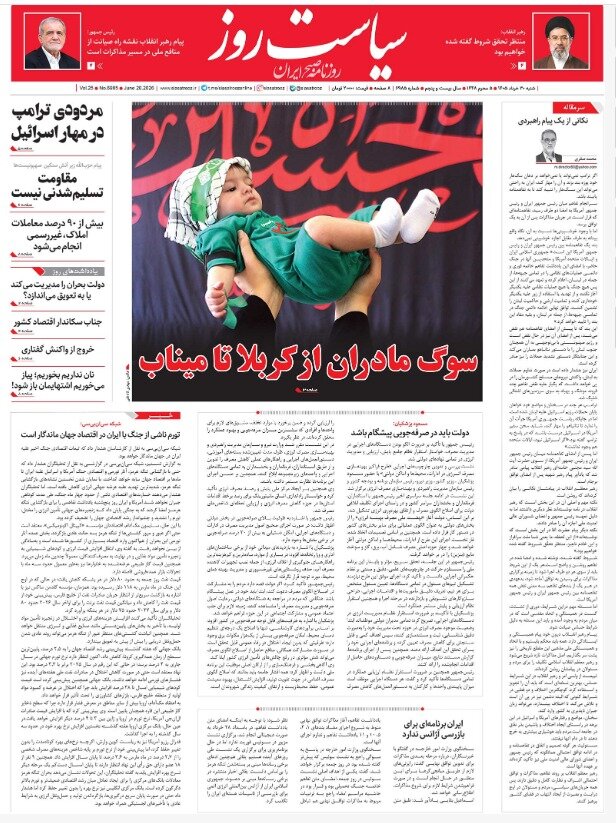
Siasat-e-Rooz devoted its editorial to one of the clauses in the recent understanding, which requires ending the war on all fronts of the Resistance Axis — a clause Israel has violated. According to the paper, if Trump cannot or does not want to restrain the Zionist regime, Iran can easily discipline it to ensure compliance with the agreement.
This clause had already been violated before the agreement was signed, and it continues to be violated afterward. Ignoring the provision, the Zionist regime is still bombing southern Lebanon under Netanyahu’s orders, and this “criminal,” as the paper describes him, has even ordered intensified attacks. Iran has warned that continued strikes on Lebanon will trigger a response from its armed forces — a warning that was previously carried out when several missiles and drones were launched toward the occupied territories in reaction to violations of the agreement. Although Trump has publicly called for an end to Israel’s attacks on Lebanon, he lacks the courage, in his role as US president, to restrain Netanyahu. Perhaps the US ambassador to Israel was right when he told Trump: “If Israel didn’t exist, the United States wouldn’t exist either.”
Donya-e-Eqtesad: A new tourism regime in the Middle East
Donya-e-Eqtesad examined the damage the Ramadan War inflicted on regional tourism. Before the conflict, the global and West Asia tourism landscape looked very different, but conditions have now changed. To better understand the crisis, the paper categorizes the war’s impacts into four groups: decline in inbound tourist flows, increased final costs of travel packages, damage to the mental image of the region among tourists and investors, and extra-regional spillover effects. Global tourism has been hit by a major crisis centered in West Asia, casting a shadow over travel worldwide. Although the US president ordered what he imagined would be a “short and swift” war in the Middle East, its consequences have spiraled out of control, affecting many parts of the world. Nearly four months later, the effects have still not subsided. Estimates suggest that if the crisis continues, a full global recovery of travel — after flights resume — will require more than five to six months.
Khorasan: From the slogan of partnership to economic reality
Khorasan analyzed Iran’s strategic partnership with China. One of the key issues, the paper argues, is the financial settlement mechanism for bilateral trade. Although a large share of Iran’s foreign trade appears to be conducted with China, in practice the settlement process is often indirect and routed through intermediaries, with the UAE, especially Dubai, serving as a major hub. The concept of a “strategic partnership with China” has been repeatedly invoked in Iran’s economic and political discourse. But experience shows that a real economic partnership depends above all on practical infrastructure. Without it, even if China remains Iran’s top trading partner, much of the trade will continue to pass through costly, vulnerable intermediary channels. Thus, Beijing’s key will only turn in the lock of Iran’s foreign economy when the Dubai bottleneck, dependence on the dirham, and the concentration of settlement networks in a single hub are replaced by a diverse, multi‑path, and resilient financial architecture.
Ettelaat: Why were the Iran–US talks in Geneva canceled?
Ettelaat examined the reasons behind the cancellation of the Geneva meeting. What we are seeing now, the paper argues, resembles the first serious crisis after the signing of the understanding, rather than a weakening of its foundations. Three main actors are currently testing each other’s will and capacity: Israel, trying to show that no new regional order can emerge without its security concerns being addressed; Iran, trying to prove that an agreement with the US does not mean abandoning its regional and security priorities; and the United States, attempting to create a stable balance between these conflicting realities. For this reason, what happened in Switzerland should be viewed as part of a larger struggle over the shape of the future regional order. The fate of the agreement will not be determined by the cancellation of a single meeting, but by how these crises are managed. If the parties can navigate this phase, the agreement will enter a stage of consolidation. But if field tensions and pressure from opponents overwhelm diplomacy, this temporary pause may become the beginning of a gradual erosion of an agreement that is still in its earliest steps.
Leave a Comment