Setting the rules of ownership in the Strait of Hormuz
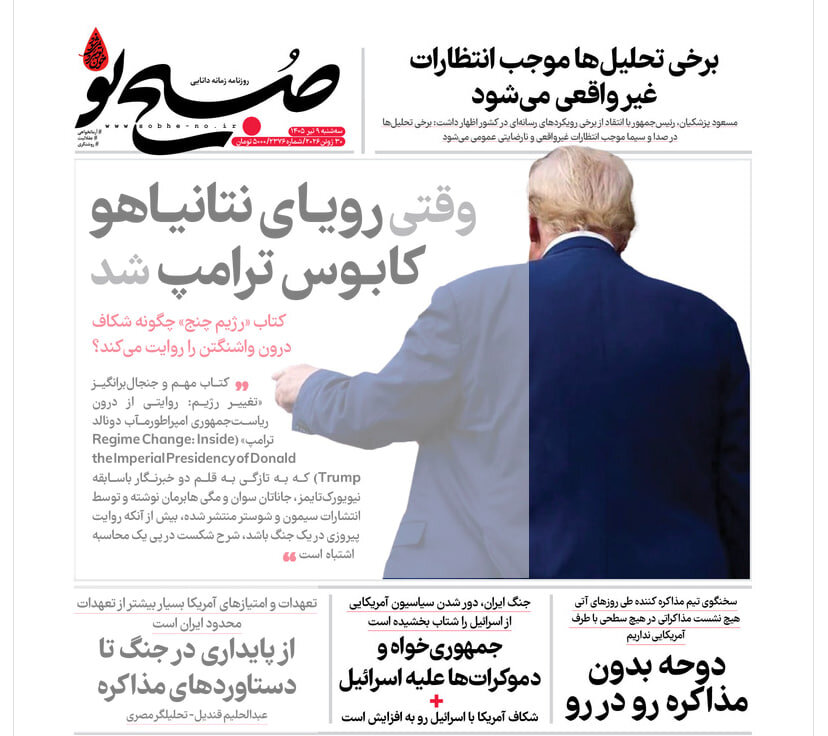
Sobh-e-No analyzed the recent exchange of fire between Iran and the United States. The region has now entered a new phase of low-intensity but continuous tensions. Under such circumstances, a return to the previous situation seems highly unlikely. The most probable scenario is the continuation of an unstable ceasefire accompanied by limited clashes and reciprocal economic pressure.
Both sides use these confrontations as leverage in negotiations. Iran has turned sovereignty over the Strait of Hormuz into a “red line,” while the United States, due to domestic pressure, needs to project strength. In short, the recent exchange of fire is a battlefield for determining the ownership of the rules governing the Strait of Hormuz. The US seeks to change these rules through economic and military tools, while Iran aims to consolidate new rules through asymmetric warfare. In this game, implementing the memorandum of understanding has become a secondary goal, and the final victory belongs to the side that can impose its will on the other.
Jam-e-Jam: From a fragile truce to first test of the agreement
Jam-e-Jam analyzed the recent clashes in southern Iran, arguing that when the events of the past few days are juxtaposed, they form a picture beyond a temporary confrontation. Past agreements have shown that the main dispute sometimes arises not from the text of the agreement but from how it is interpreted and implemented. What is happening today in the Strait of Hormuz is not merely a legal disagreement over a single clause. From the outset, Washington defined its most important expected outcome of the agreement as restoring the Strait of Hormuz to its pre-war conditions. In this framework, the release of part of Iran’s financial assets, increased oil exports, and the facilitation of certain economic exchanges are not the end of pressure but part of a larger equation in which economic incentives are used alongside security pressure to push Tehran toward accepting the arrangements desired by the United States regarding the Strait of Hormuz.
Arman-e-Emrooz: New diplomatic opportunities
Arman-e-Emrooz highlighted the new diplomatic opportunities and the need to make maximum use of them. Quoting political analyst Abdolreza Kahani, the paper wrote: Military strength, national cohesion, political management, and active diplomacy together created this opportunity for the Islamic Republic of Iran, and now the most important issue is how to use this capacity to secure national interests. The current regional environment—including the shift in approach by some neighboring countries and their increased willingness to expand relations with Iran—is the result of the change in balance of power and Iran’s enhanced regional standing. If this capacity is not used at the right time, it may gradually fade. Therefore, the foreign policy apparatus and decision-making institutions must, with coordination and strategic vision, use this moment to secure national rights, reduce external pressure, and expand regional and international cooperation.
Ettelaat: Iran’s valuable achievements
Ettelaat interviewed Mohammad Hashemi Rafsanjani, a member of the central council of the Executives of Construction Party, about the dimensions of the memorandum of understanding (MOU) between Iran and the U.S., which sets the roadmap for an agreement following the Feb. war against the Islamic Republic. The veteran politician says: Today, not only Iran but all regional countries need stability, security, and new economic opportunities. This agreement paves the way for significant gains in trade, the energy market, and especially oil. Politically, it has also had positive effects. Iran’s position, coupled with its regional and even global power, has increased. Today, Iran is recognized as one of the influential regional powers, and no one can easily think of weakening or eliminating it. Moreover, the Islamic Republic has clearly stated its positions on various issues, including negotiations, security, energy, and missile capabilities, and these issues have been addressed within the framework of the agreement. Therefore, we hope to see valuable achievements and favorable conditions for the country, the region, and even the world.
Farhikhtegan: US is creating parallel tracks to the agreement
Farhikhtegan examined the US approach after the recent agreement and wrote: The US Navy’s Joint Information Center announced the expansion of a maritime corridor near Oman’s coast—a route that, according to the US, increases the possibility of ships traveling in both directions. In response, Iran’s armed forces declared that the only safe and legal route for ships is the one managed by Iran, and vessels using unauthorized routes will be confronted. When these developments are placed alongside the clauses of the agreement, the message becomes clear: the United States is creating parallel tracks to the agreement. The Trump team is trying to define alternative routes to reduce international shipping’s dependence on Iran’s management in the Strait of Hormuz. Even if such actions are presented as facilitating passage, they can be interpreted as moves contrary to the agreement and as efforts to limit one of Iran’s most important leverage points.
Leave a Comment